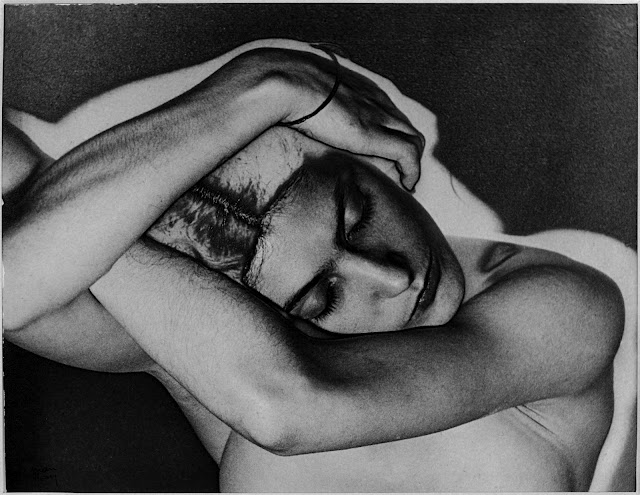
Man Ray's was succesfull in both the United States and Europe. He matured in the center of American modernism in the 1910s, and made Paris his home in the 1920s and 1930s, and in the 1940s he went back, spending periods in New York and Hollywood. His art comprised painting, sculpture, film, prints and poetry, and in his amazing career he worked in styles ranging from Cubism, Futurism, Dada and Surrealism. He also balanced the worlds of commercial and fine art, and came to be a renowned fashion photographer. He is perhaps most remembered for his photographs of the inter-war years, in particular the camera-less pictures he called 'Rayographs', but he always considered himself first and foremost as a painter.
Showing posts with label art. Show all posts
Monday, July 16, 2012
Saturday, June 23, 2012
Alfred Stieglitz
Alfred Stieglitz (January 1, 1864 – July 13, 1946) was an American photographer and promoter of modern art who was essential over his fifty-year career in making photography an accepted art form.
"A vital force in the development of modern art in America, Alfred Stieglitz's significance lies as much in his work as an art dealer, exhibition organizer, publisher and editor, as in does in his career as a photographer. He is credited with spear-heading the rise of Pictorial Photography in America, in the early years of the 20th century, publishing the periodical Camera Work (1903-1917) and forming the exhibition society, the Photo-Secession. He also ran a series of influential galleries, starting with 291, which he used not only to exhibit photography but also to introduce European modernist painters and sculptors to America, and to foster America's own modernist figures - including his later wife, Georgia O'Keeffe. Insistent that photography warranted a place among the fine arts, Stieglitz's own work showed great technical mastery of tone and texture, and reveled in exploring atmospherics. In later years, influenced in part by Cubism and other trends, he became interested in Straight Photography, favoring more clarity and less lush effects. " (The art history.com)
Wednesday, May 16, 2012
Friday, February 17, 2012
How much are we missing out?
This is one of the stories that I saw posted by a friend on Facebook and it made me think and feel a little bit ashamed of myself since I consider myself someone that looks for beauty in every thing but I identify as one of the untouched passers. Heres the story:
A man sat at a metro station in Washington DC and started to play the violin; it was a cold January morning. He played six Bach pieces for about 45 minutes. During that time, since it was rush hour, it was calculated that 1,100 people went through the station, most of them on their way to work.
Three minutes went by, and a middle aged man noticed there was musician playing. He slowed his pace, and stopped for a few seconds, and then hurried up to meet his schedule.
A minute later, the violinist received his first dollar tip: a woman threw the money in the till and without stopping, and continued to walk.
A few minutes later, someone leaned against the wall to listen to him, but the man looked at his watch and started to walk again. Clearly he was late for work.
The one who paid the most attention was a 3 year old boy. His mother tagged him along, hurried, but the kid stopped to look at the violinist. Finally, the mother pushed hard, and the child continued to walk, turning his head all the time. This action was repeated by several other children. All the parents, without exception, forced them to move on.
In the 45 minutes the musician played, only 6 people stopped and stayed for a while. About 20 gave him money, but continued to walk their normal pace. He collected $32. When he finished playing and silence took over, no one noticed it. No one applauded, nor was there any recognition.
No one knew this, but the violinist was Joshua Bell, one of the most talented musicians in the world. He had just played one of the most intricate pieces ever written, on a violin worth $3.5 million dollars.
Two days before his playing in the subway, Joshua Bell sold out at a theater in Boston where the seats averaged $100.
This is a real story. Joshua Bell playing incognito in the metro station was organized by the Washington Post as part of a social experiment about perception, taste, and priorities of people. The outlines were: in a commonplace environment at an inappropriate hour: Do we perceive beauty? Do we stop to appreciate it? Do we recognize the talent in an unexpected context?
One of the possible conclusions from this experience could be:
If we do not have a moment to stop and listen to one of the best musicians in the world playing the best music ever written, how many other things are we missing?
Monday, June 6, 2011
Nick Gentry's floppy disks
London based artist Nick gentry brings back our beloved old school floppy disks using a little bit of pop art, modern art and creativity using the disks as a blank canvass and combining them with paintings on top of them. Probably the younger generations don't feel as identified with this item as other generations...
Subscribe to:
Posts (Atom)